
Champion-Challenger Guide for Lakehouse ML
If a new model has not beaten the live model under the same traffic, same features, and fixed guardrails, I would not promote it.
This guide comes down to a simple system: keep the current model live, test a new one in shadow or a small canary, log every request, and promote only when the numbers clear pre-set gates. In practice, that means using one shared feature layer, registry aliases like @champion and @candidate, traffic splits such as 95/5 or 99/1, and rollback rules that can flip back in one step.
If I had to boil the full article down, it says to do these things:
- Use the same features for both models so the test is clean
- Store model versions and aliases in MLflow so promotion and rollback are controlled
- Set gates before testing starts for model quality, latency, drift, subgroup checks, and cost
- Start with shadow mode, then move to 1%–5% canary traffic
- Log every prediction and every alias change in append-only Delta tables
- Keep the last live model ready as a fallback
- Promote only after enough live volume, such as 50,000+ events and 95% confidence
- Auto-rollback on hard breaches, like p95 latency over target or error rate above 0.5%
A quick way to think about it:
| Stage | User impact | Traffic | Main goal |
|---|---|---|---|
| Shadow | None | 0% | Check latency, errors, and score behavior |
| Champion-challenger | Low | 95/5, 90/10, 99/1 | Compare live results on a small slice |
| Canary rollout | Controlled | 1% to 100% | Replace the old model step by step |
| Rollback | Controlled | Back to old model | Recover fast after a breach |
Bottom line: I’d treat the lakehouse as one control plane for data, features, models, logs, and rollback. That is what turns model promotion from a guess into a recorded process.
A/B Testing & Canary Deployments for ML Models: Safe Rollouts in Production | Uplatz
sbb-itb-61a6e59
Lakehouse Architecture and Feature Pipelines
A simple way to set this up is to use bronze for raw data, silver for cleaned data, and gold for ML-ready features keyed by entity and timestamp.
Bronze holds raw ingested data from batch sources like CSVs and database dumps, plus streaming sources like Kafka or Kinesis. Silver is where you clean things up: deduplicate records, normalize fields, standardize timestamps, convert currency amounts to USD, and line up entity IDs. Gold is where feature tables for ML live, keyed by entity IDs and timestamps. Before any traffic split happens, those feature tables should be linked to registry metadata.
The key idea is simple: champion and challenger should use the same feature layer.
For batch inference, a scheduled job scores the same gold features with both registry aliases, then writes scores, model versions, and timestamps to a prediction Delta table. For online inference, one serving endpoint fetches features once per request, routes traffic based on the split, and logs every prediction for audit and side-by-side comparison. That shared serving path is what makes the promotion call measurable instead of guesswork.
Keep feature pipelines consistent across training and serving
If feature definitions drift between training and inference, the whole champion-challenger test falls apart. It’s like timing two runners on different tracks.
The fix is to define each feature once and register it in Databricks Feature Store. That same definition is then used for offline training datasets, batch scoring jobs, and online inference endpoints. When training data is built, Feature Store enforces point-in-time correctness automatically: it joins only feature values with timestamps at or before each label’s event timestamp, which prevents data leakage. Both models read from the same feature view, so the logic stays aligned even if one model uses only part of the feature set.
Schema contracts matter too. Standardizing primary keys like user_id, account_id, or a composite key across bronze, silver, and gold tables helps avoid ad hoc join mismatches at serving time. Delta constraints and schema enforcement keep column names, types, and units in sync so models keep getting the same fields every time.
Choose batch, streaming, or on-demand features based on latency and cost
The best pipeline type depends on two things: how fresh the signals need to be, and what your team can afford to run day to day. In a champion-challenger setup, both models should use the same pipeline type. If one gets fresher inputs than the other, the comparison isn’t fair.
| Pipeline Type | Typical Latency | Cost | Complexity | Best-Fit Scenarios |
|---|---|---|---|---|
| Batch | Minutes to hours | Low | Low to medium | Nightly churn scores, weekly credit risk ratings, daily marketing propensity |
| Streaming | Seconds to a few minutes | Medium to high | Medium to high | Real-time fraud detection, dynamic pricing, clickstream recommendations |
| On-demand | Milliseconds to seconds | Medium | Medium | Session-based scoring, ad bidding, context-aware personalization APIs |
In Databricks, batch pipelines run as scheduled jobs over Delta and Feature Store gold tables. Streaming pipelines use Structured Streaming from bronze through silver and gold, then feed an online store or another low-latency serving path. On-demand pipelines compute lightweight features per request, often mixing them with cached batch or streaming values.
Bundle feature lookups with the model
It helps to package feature lookup rules with the model itself. That means logging the feature specs along with the model: which tables it needs, which primary keys it uses, and which aggregation windows apply. With that metadata stored, the serving layer can handle lookups automatically.
Databricks' score_batch utility can use stored feature metadata during batch inference so the model scores on the same schema it was trained on. That cuts out a whole class of quiet bugs where inference gets slightly different columns than training did. For champion-challenger work, this also makes deployment much easier. You can push a new challenger without manually wiring its feature pipeline each time, because the registry metadata carries those lookup rules forward.
Feature metadata should make the right lookup and scoring path happen by default. Then features, aliases, and promotion rules can be registered in a way that keeps rollout decisions repeatable.
Model Registry Setup and Governance Rules
Feature consistency solves only part of the control problem. The registry also needs to enforce promotion rules.
Once feature metadata is in the registry, treat the registry as the control plane for promotion, rollback, and approval. Keep the lifecycle clear with states like None, Staging, Production, and Archived.
Models should move from None to Staging, then to Production only after offline checks. Versions marked Archived should stay in the registry for audit and rollback history. Governance rules also need to spell out which roles can move a model from one state to another, so approvals are clear and traceable.
Use aliases such as @champion and @candidate
Aliases let you load models:/fraud-score@champion without hard-coding version numbers. That makes promotion and rollback as simple as updating an alias.
A small alias scheme is enough for most champion-challenger setups:
| Alias | Role | Traffic Exposure | Purpose |
|---|---|---|---|
@champion |
Current production model | Majority of live traffic | The default scoring path for all user-facing requests |
@candidate |
Primary challenger | Small canary share | Passed offline gates; under live evaluation |
@shadow |
Silent challenger | 0% (logs only) | Silent challenger used for logged comparisons only |
@baseline |
Fallback or legacy model | 0% (rollback target) | Stable recovery reference used when the champion is rolled back |
More than one alias can point to the same version. So if you want a steady control while testing two challengers at the same time, @champion and @baseline can both point to one version with no artifact duplication.
That said, aliases only work well when registry tags and approval records are complete.
Attach the metadata needed for repeatable decisions
Every registered model version should include tags that let you reconstruct what was trained, which data it used, and who approved the promotion.
This matters a lot in U.S.-regulated fields like financial services and healthcare, where model governance depends on a documented evidence trail for every production model.
Required fields per version:
- Git commit SHA - links the artifact to the exact training code
- Training data snapshot ID - a Delta Lake table version or dataset hash
- Feature set version - feature view names and versions from the feature store
- Evaluation metrics - AUC, RMSE, calibration error, or use-case KPIs
- Owner - team name or on-call email
- Approval timestamp and approver identity
- Runtime environment - Python version, library versions, Databricks runtime tag
These fields can be filled automatically in CI/CD. Git commit SHA can come from environment variables like GIT_COMMIT. Delta table versions can come from DESCRIBE HISTORY. Feature store APIs return view names and versions that can be logged straight into model tags. Ownership metadata can sit in a config file.
The point is simple: if the training pipeline captures this once, no one has to type it in by hand later.
Define promotion gates before live traffic
Promotion gates are the conditions a candidate must meet before it touches canary traffic at all. Set them before training starts. If you wait until after the results show up, people start looking for reasons to bend the rules.
A practical gate set usually covers four areas:
- Performance: Challenger AUC, RMSE, or the right equivalent metric must hit a minimum absolute threshold and also improve on the champion. For example, AUC ≥ champion AUC − 0.01, or RMSE improves by at least 2%.
- Guardrails: Secondary KPIs like false positive rate, calibration error, or bad-debt rate must not get worse beyond a set limit.
- Fairness: For credit, hiring, or healthcare models in the U.S., group-level disparity metrics like disparate impact ratio must stay within defined bounds.
- Latency: p95 response time must stay within the service-level objective, with p99 capped at an agreed maximum increase.
Sometimes a challenger clears every gate and still is not meaningfully better than the champion. Maybe the confidence intervals overlap. Maybe the metric lift is tiny. In cases like that, keep the current champion.
That might sound conservative, but it’s the right kind of conservative. Stability matters. Swapping models without a measurable gain adds risk for no good reason, so that default should be written into the gate definition instead of left to judgment at the last minute.
With registry gates in place, the next move is to test and log every live decision before any traffic shift.
Testing Rules, Audit Logs, and Rollout Flow
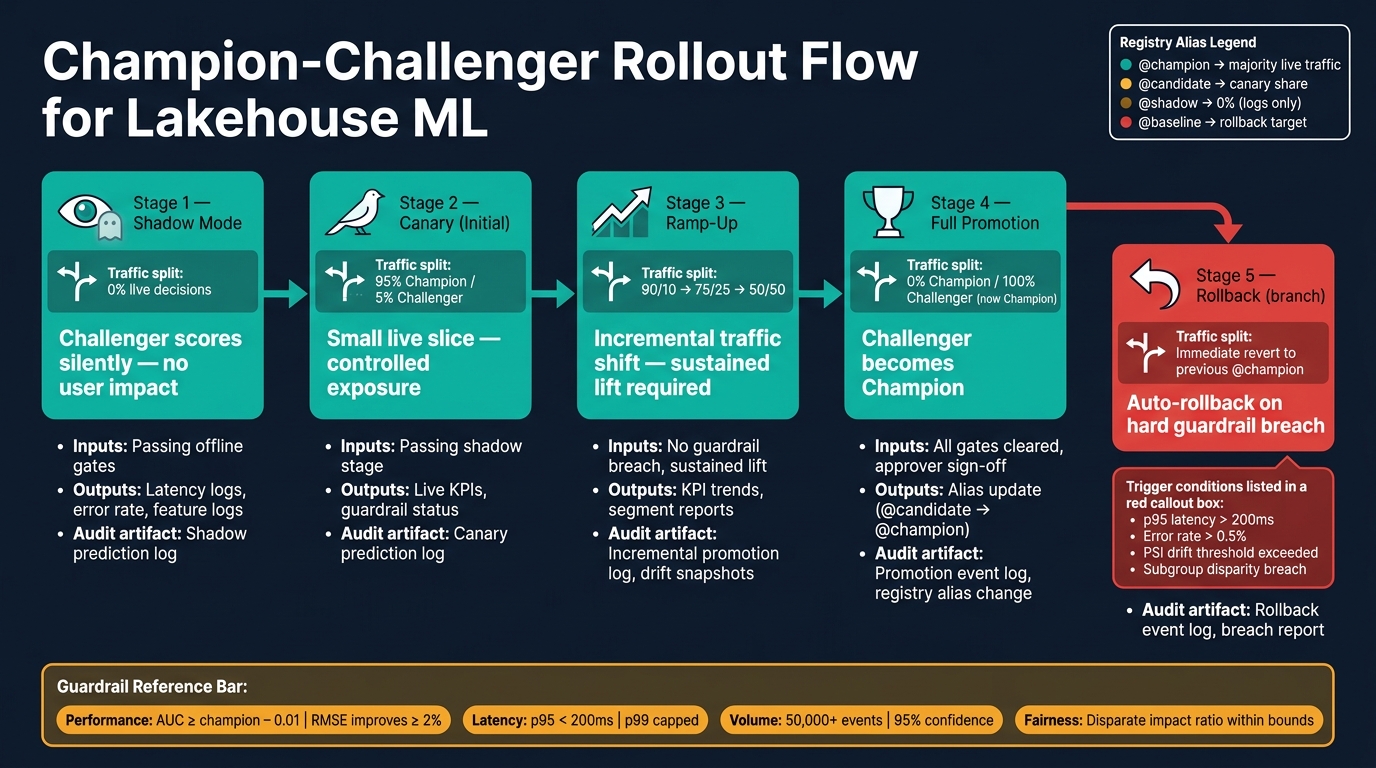
Champion-Challenger Model Promotion: Stages, Traffic Splits & Guardrails
With promotion gates in place, the next job is simple in theory and strict in practice: test the challenger, log every call, and move traffic in small, controlled steps.
Set offline and online test rules with clear guardrails
Before a challenger sees live traffic, it should pass offline evaluation. Offline tests are fast and low-cost, which makes them useful for screening obvious issues early. But they have limits. They won't show how the model behaves under live load, how users react, or what odd production cases show up at 2:00 a.m. So offline evaluation is a filter, not a final decision.
After the gates are defined, test them on offline data first, then on live traffic. Put those gates into a versioned scorecard with clear pass/fail thresholds. Pick one primary metric based on the use case. Then require the challenger to beat the champion by a minimum margin - often 3–5% on the primary metric on out-of-time validation data - with at least 95% confidence and a minimum sample size of 50,000 events before making the call.
If a challenger drops by more than 2% on any segment with 10,000 or more events, reject it.
Here’s how offline and online testing compare for promotion decisions:
| Setting | Data source | Risk | Speed | Decision quality |
|---|---|---|---|---|
| Offline evaluation | Historical labeled data in the lakehouse | Low; no user exposure | Fast to iterate | Good for screening; limited by simulation assumptions |
| Online shadow testing | Live requests scored silently by the challenger | Low user risk; infra cost only | Medium; depends on logging setup | High for latency and reliability; limited on business impact |
| Online champion-challenger | Live traffic split between models | Medium; controlled via traffic splits | Slower; needs time and volume | Highest; captures real behavior and environment |
Online guardrails need tighter limits. For real-time APIs, the challenger should keep p95 latency under 200 ms, error rate below 0.5%, and stay under the cost ceiling, usually set as a maximum cost per 1,000 predictions. Set PSI drift thresholds on key features and output scores before launch. For fairness-sensitive use cases, subgroup disparity metrics need to stay inside defined bounds, with a hard kill switch if they don't.
Log every prediction and every promotion decision
Logs should drive every rollout step. Every prediction needs a permanent record. At a minimum, prediction-level logging should include request_id, timestamp (ISO 8601 with time zone, for example 2026-08-26T14:32:10-04:00), model_alias, model_version, feature values or a feature_vector_hash for sensitive inputs, predicted_value, response_latency_ms, and observed_outcome when it becomes available.
It's also smart to split feature_lookup_latency_ms from model_inference_latency_ms. That small detail makes incident work much easier because it shows where the slowdown actually happened.
Store these logs in append-only Delta Lake tables, partitioned by date and model alias. That setup supports compliance audits, drift checks, and incident debugging. In Databricks Unity Catalog-backed registries, alias-change events are recorded in the audit trail, which gives a clear record of who changed what and when.
Promotion decisions need their own log too. Each alias change should record:
- The event type:
promotion,demotion, orrollback - The old and new alias states
- The rollback target version
- The identity and role of the person who made the change
- The approval workflow ID, if multi-step sign-off was required
- Links to the offline and online check reports that supported the decision
Roll out with canary stages and automatic rollback
Start with shadow mode, then move into live canaries. In shadow mode, the challenger scores every production request, but its outputs are ignored for actual decisions. This is the dress rehearsal. If shadow results look clean, move the challenger into a small live canary slice.
Ramp traffic from 1%–5% to 10%, 25%, 50%, and then 100% if the guardrails keep holding. In high-risk domains, it's common to stay at 1–5% longer before moving ahead.
The rollout stages, required inputs, outputs, and audit artifacts look like this:
| Stage | Traffic split | Inputs required | Outputs | Audit artifacts |
|---|---|---|---|---|
| Shadow | 0% decisions | Passing offline gates | Latency, error rate, feature logs | Shadow prediction log, pipeline health report |
| Canary (initial) | 95/5 champion/challenger | Passing shadow stage | Live KPIs, guardrail status | Canary prediction log, guardrail check record |
| Ramp-up | 90/10 → 75/25 → 50/50 | Sustained lift, no guardrail breach | Updated KPI trends, segment reports | Incremental promotion log, drift snapshots |
| Full promotion | 0/100 (challenger becomes champion) | All gates cleared, approver sign-off | Alias update, rollback target set | Promotion event log, registry alias change record |
| Rollback | Immediate revert to previous champion | Any hard guardrail breach | Champion restored, incident flag | Rollback event log, breach report |
Rollback needs to be fast and deterministic. The previous champion should always be one alias flip away. Set rollback triggers before the canary begins, and tie them to the canary's live baseline, not old averages. If any hard guardrail crosses its limit, the system should revert automatically, flag the incident, and write the exact breach values into the promotion log so there's no guesswork later.
With the rollout path set, the next step is to turn it into a standard operating process. That shifts promotion from a one-time judgment call to something teams can run the same way every time.
Conclusion: A Champion-Challenger Blueprint for Lakehouse ML
Taken together, these controls make model promotion a process you can run the same way again and again. A strong champion-challenger setup is not about chasing offline metrics. It is about making promotion calls with reproducible, auditable evidence instead of ad hoc judgment.
In practice, a lakehouse stack helps make promotion repeatable because data, features, testing, logging, and rollout live under one control plane.
Use this checklist:
- Governed features: Version feature tables in Unity Catalog so lineage, freshness, and access control stay aligned.
- Clear aliases: Use
@championfor production and@candidatefor the active challenger. - Predefined guardrails: Set performance, drift, latency, and business-impact thresholds before launch.
- Complete audit logs: Log model version, feature version, training snapshot, approvals, deployment time, inputs, outputs, and rollback events.
- Rollback-ready rollout: Use shadow or canary rollout with automatic rollback on guardrail breach.
Lakehouse architecture makes this practical because it puts data, features, and model artifacts in one governed environment. That cuts training-serving skew and makes champion-challenger comparisons more reliable. A challenger that earns promotion through this process is one stakeholders and auditors can defend. It makes each promotion traceable from training data to rollback.
FAQs
When should I use shadow testing instead of a canary?
Use shadow testing when deploying new AI-generated rules or models and you need to log performance and violations without changing production behavior.
Here’s the idea: the new logic runs in parallel with the current production system. That lets you watch how it performs, track violations, and fine-tune thresholds before you turn on active enforcement. It’s a safe way to spot false positives early, while production keeps running as usual.
A canary works differently. Instead of running quietly in the background, it sends a slice of live traffic to the new version.
How do I choose the right promotion guardrails?
Treat governance as enforceable controls, not paperwork.
Use a centralized catalog to register and tag sensitive objects. Then enforce access with ABAC, row filters, and column masks. On top of that, require CI or pull-request checks so pipelines or models can't merge unless they include tags, masking policies, and lineage metadata.
You also need negative tests for restricted access. In plain English, people and systems that should be blocked must actually be blocked. Verify masking across notebooks, jobs, SQL, and BI exports so the same rules hold up everywhere, not just in one interface.
Finally, require audit-ready logging, plus control tests after changes and on a set schedule. That way, governance isn't just written down. It works when someone tries to use the data.
What should I log for fast rollback?
Log a clear traceability chain: the training commit SHA in MLflow, the exact training run, and the dataset version tied to the production model.
Also use a centralized registry like Unity Catalog to track versions from experimentation to production. That gives you one place to follow what changed, when it changed, and what made it into production.
On top of that, follow the write-audit-publish pattern. In plain English, write data first, audit it before anything moves forward, and publish ONLY the data that passes checks. That way, validated data is what gets promoted, and the lineage record stays clear from end to end.